The cannabis industry desperately needs banking solutions. Loans are crucial. Cash needs to be deposited. Etc. Yet, due to its unusual legal status — illegal at the federal level and of varying degrees of legality in different states — many banks are hesitant to engage with the industry, lest they be swept up in federal investigations. The SAFER Banking Act seeks to ease this dilemma for both banks and cannabis operators by reducing the likelihood that a federal banking regulator could penalize banks in several ways, including discouraging them from working with cannabis businesses or treating proceeds from legal cannabis operations as unlawful activity.
The Act has passed the House of Representatives but remains stalled in the Senate, despite ongoing support. Although the Act may seem beneficial, it still warrants closer scrutiny. Read on to learn more about this complex Act, its limitations, and possible improvements.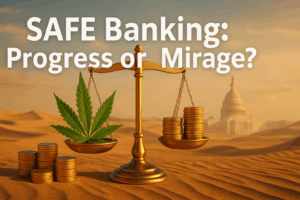
Promises vs. Gaps
As mentioned above, the SAFER Act helps remove some roadblocks for banks, such as providing “safe harbor” from federal prosecution or penalties for serving the cannabis industry. The Act would also expand access for insurance companies and specify that deposits, loans, insurance, and payments provided to cannabis operators are not in violation of federal law.
The SAFER Act is also not without its flaws. Chief among these issues is that it does not change cannabis’ federal status or ensure it is entitled to complete banking services, such as lines of credit and loans. This is a bit like sending your kid to someone’s house for a sleepover when there’s a good chance someone in the house has a highly contagious disease. There’s a chance your kid won’t get sick, but do you really want to take that chance? Similarly, many large banks and credit unions could still be reluctant to deal with a federally illegal industry, thereby exposing themselves to charges such as money laundering, potential asset forfeiture, and possible regulatory penalties.
And loans? Many in the cannabis industry could always benefit from greater access to loans, given the exorbitant start-up costs and ongoing maintenance; a cash infusion is always welcome. Being potentially deprived of access to funds is a significant blow.
But the issues don’t stop there.
The Act is also somewhat misleading, as it doesn’t eliminate the risk that bank employees could be arrested for receiving deposits or allowing withdrawals of $10,000 or more in cash from the distribution or sale of cannabis, according to the Congressional Research Service (CRS). Banks would also still be able to deny cannabis operators services at their discretion, and it doesn’t address the fact that the industry has historically faced discriminatory banking practices. Thus, there would be no guarantee of equitable access.
Who Gets Left Out
To elaborate on the last point, the SAFER Act does not necessarily address the historic discrimination that communities of color have faced. According to an analysis by Ohio State University, the Act would do little for communities of color, small businesses, equity applicants, or those harmed by the War on Drugs. This limitation is mainly due to the Act being focused on protecting financial institutions but not requiring them to treat all cannabis businesses fairly — opening the door for financial institutions to continue denying services to select (read: minority) groups.
This isn’t to say there haven’t been repeated requests for amendments to the Act. The Cannabis Regulators of Color Coalition (CRCC), for example, has frequently proposed amendments mandating that financial institutions demonstrate compliance with anti-discrimination laws to receive SAFE protections. Moreover, the extensive compliance requirements and the time it will take for economic access to improve are significant, as small farms lack the resources to sustain themselves while trying to stay competitive and meet the persistent need for capital.
Where Advocacy Goes Next
With the Act still in the legislative process, there’s time for amendments. Many would benefit if the Act allowed cannabis businesses full banking access; that way, they could obtain the loan assistance they often need, as well as lines of credit, payroll services, and other vital financial services. The Act could also adopt the proposed amendments by the Cannabis Regulators of Color Coalition (CRCC) to serve communities of color better.
Other recently proposed amendments would protect bank employees themselves. Again, you might be more likely to let your kid stay over at a friend’s house if you knew no one living there had a highly contagious disease. Likewise, bankers might be more likely to serve cannabis operators if they weren’t worried about being penalized for doing their job.
And, of course, the new amendments would lower the risks that banking institutions face, including penalties, asset seizures, and more. Newly proposed amendments would also simplify tax compliance and reduce the need to operate as a cash-only business, thereby mitigating many associated risks.
Conclusion
For quite a while, the cannabis industry has been federally illegal. For quite some time, it has been challenging for those in the industry to access comprehensive banking services for their operations. And for quite some time, it has been hard for those most affected by the War on Drugs to be treated fairly by the banking industry.
The SAFER Act should help ameliorate some of these issues. But much like if you were living in a tent and someone offered to buy you a house, you’d be grateful. If the house came with caveats — perhaps there was no running water or electricity, and there was a live-in python on the premises — you might be less than thrilled. And your neighbors might wonder why you got a house and they didn’t.
We don’t need to treat the SAFER Act like it’s an act of charity, and we should not just be grateful — Python and all. The cannabis industry is heavily taxed and provides thousands of jobs as the nascent industry grows stronger. There should be no reason for the industry to accept half-measures when survival is already tenuous for most.
At BTA Cannabis CPA Tax, we’ll be there to help you with all your accounting and tax needs as the laws change, amendment by amendment. Reach out today — we’d be happy to assist you.